Search

Displaying 6141 - 6150 of 7657

Wie Organisationskultur den Erfolg von hybriden Arbeitsplatzkonzepten* beeinflusst.

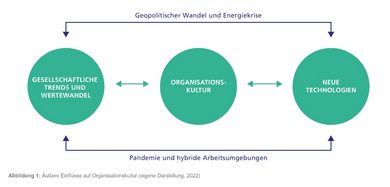
Die Kultur von Organisationen hat einen großen Anteil daran, wie diese langfristig mit den arbeitsorganisatorischen Herausforde

Image

Kontinuierlich erobern beispielsweise technische Innovationen den Markt, die Einfluss auf die Produkte und Dienstleistungen von Unternehmen, das Geschäftsmodell oder die organisationalen Praktiken haben und oft eines Umdenkens oder der Anpassung bedürfen.      

Image

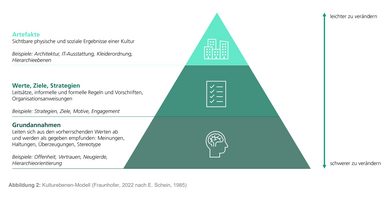
Hier wird die Unternehmenskultur als Konstrukt mit drei Ebenen beschrieben, welche unterschiedlich schwer veränderbar sind. Auf der Ebene der Artefakte hat sich durch die Pandemie vieles in einem kurzen Zeitraum verändert.

These 1: Bei Arbeitnehmer*innen wächst der Wunsch nach hybriden Arbeitssituationen – aber: nicht überall und nicht bei allen

29 - 30 January 2024
Subtitle
Prompts, Provocations and Problematizations for Society-Centered AI
Description


On behalf of the international research project Shaping 21st Century AI, the Alexander von Humboldt Institute for Internet and Society (HIIG) and the Zentrum für Medien-, Kommunikations- und Informationsforschung (ZeMKI), University of Bremen, in cooperation with the research group “Politics of Digitalization” at the WZB Berlin Social Science Center, invite to an international conference on the topic of AI controversies. 

29 - 30 January 2024
Start: 9:00 am

Contact

Contact name
Yuting Tang
yuting.tang [at] wzb.eu
The Aggregation Challenge

We have multiple projects innovating on aspects of what we call the "aggregation challenge." The aggregation challenge is the challenge of combining findings from multiple studies to foster cumulative learning.

Doing No Harm When Conducting Research in Development Countries, What about the researchers?

The purpose of this project is twofold: First, it identifies and synthesizes evidence of ethical challenges that are faced by local and international research staff implementing field research projects in the Global South.

Tuesday, 14 November 2023
Subtitle
Talk by Filiz Garip (A.SK Bright Mind Award Winner 2023)
Description


On November 14, before being presented with one of the the A.SK Bright Mind Awards later that day at the WZB, the sociologist Filiz Garip will give a specialized talk for her peers and anyone interested in the subject matter of sociological methods in researching migration:

Tuesday, 14 November 2023
Start: 10:00 am

Contact

Contact name
Friederike Theilen-Kosch
friederike.theilen-kosch [at] wzb.eu
Abstract

Theoretical background and objectives

In the light of growing migration from countries with a Muslim cultural background as well as increasing Islamic fundamentalism related to terrorist attacks in Western Europe and the US a new research field has emerged that investigates the way states and ordinary citizens react to these new phenomena. However, we know surprisingly little about the attitudes of ordinary citizens towards Islam and Muslim migrants. Islamophobia has only recently started to be addressed by social scientists. We therefore know relatively little about the extent of Islamo­phobic attitudes in Western Europe and North America and what Islamophobia exactly is.

Project Management

Research fields

Migration, Integration, and Intercultural Conflicts
Duration
2009-2011
Funding
WZB
Abstract

Theoretical background and objectives

Project Management

Research fields

Migration, Integration, and Intercultural Conflicts
Duration
2009-2011
Funding
WZB

At the heart of the study of political inequality are questions about when and how citizens can influence elites and vice versa. The cluster on vertical linkages tackles such questions with a focus specifically on the institutions that mediate these connections.

Developing Kampala's Citizen Charter: Citizen Deliberation and Bureaucratic Responsiveness in Service Provision

The politics of political inequality is poorly understood. There is certainly inequality in who participates in collective decision-making and in who influences collective decisions.

Political Accountability meta-analysis

In democratic settings, the most obvious micro-level channel for citizens to exercise political control of elites is by voting.

Autonomous Control

Nina McMurry examines state-level institutional change, the decentralization of structures for decision-making as a way to move beyond zero-sum politics.

Digital Citizenship

Lisa Garbe, Nina McMurry and Alex Scacco examine attempts by national bureaucracies to access information about citizens Governments across the Global South have begun introducing biometric IDs (eIDs) in an attempt to improve citizen-state legibility.

Does Political Voice Change Women’s Prosociality?: Evidence from a Lab in the Field Experiment in Uganda

In recent years, policy-makers across the world have implem

Image

Wheels of Change: The Impact of Bicycles on Girls’ Education and Empowerment Outcomes in Zambia

We study the impact of a program that provides a bicycle to a school-going girl who lives more than 2.5 km from the school.

Image

Networks and the Size of the Gender Gap in Politician Performance across Job Duties

The share of women in legislatures has increased dramatically in the past decade. Yet female politicians continue to face barriers that undermine their performance relative to men.

When Do Strong Parties "Throw the Bums Out? Competition and Accountability in South African Candidate Nominations"

How do party elites make decisions about which candidates to nominate?

“From Recognition to Integration: Indigenous Autonomy, State Authority, and National Identity in the Philippines"

This project examines the decentralization of state-level structures for decision-making as a way to move beyond zero-sum politics.